





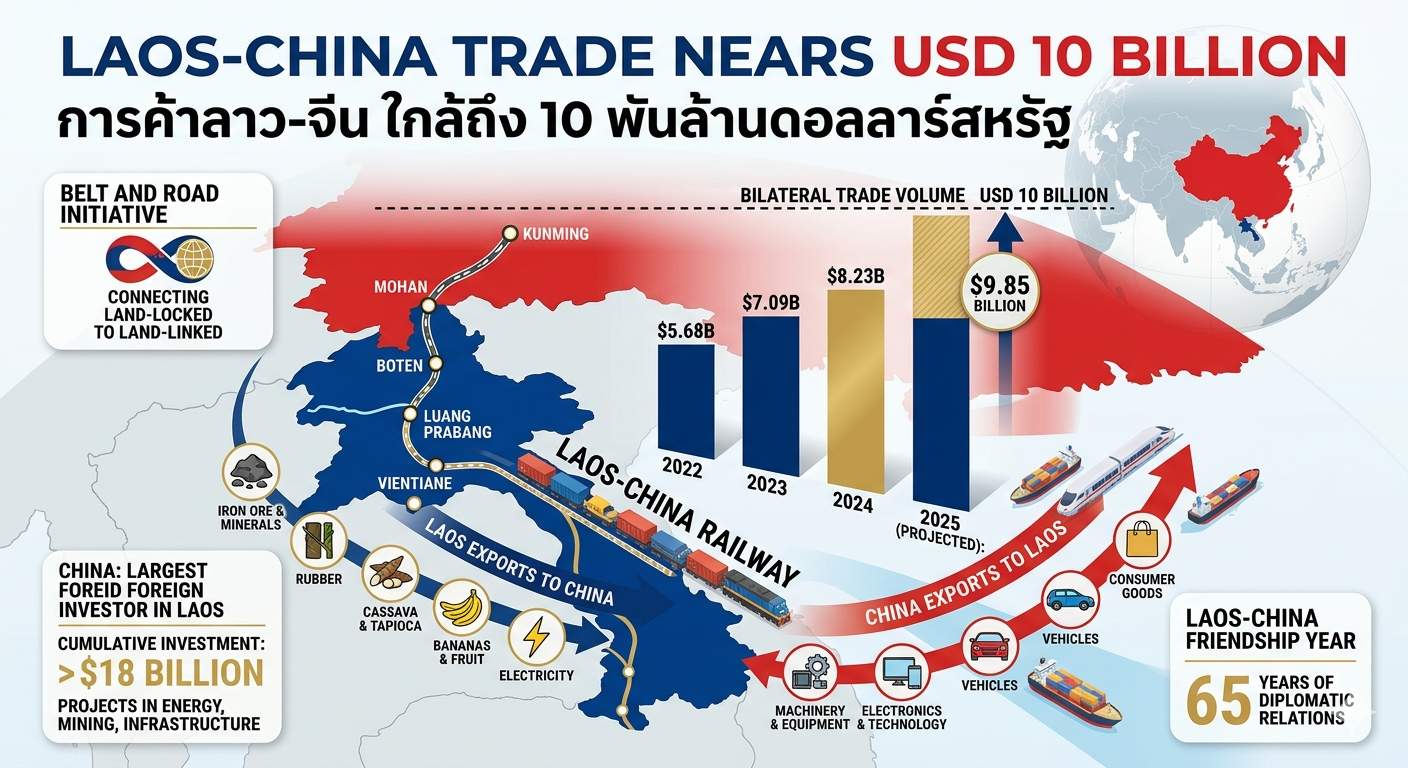
Laos and China marked 65 years of diplomatic relations this week, with both sides highlighting deepening economic ties, including more than USD 18 billion in Chinese investment in Laos to date.
Bilateral trade reached nearly USD 9.8 billion in 2025, up 19.3 percent from a year earlier.
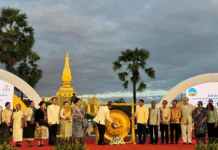
Officials and diplomats from both countries presented the figures in a ceremony in Vientiane on 23 April.
Chinese Ambassador to Laos Fang Hong and Lao Minister of Foreign Affairs Thongsavanh Phomvihane described the partnership as increasingly important amid global uncertainty, calling it a stable, long-term relationship with growing strategic value.
According to the data. tourism has also rebounded. More than one million Chinese visitors traveled to Laos in 2025, a 24.32 percent increase, reinforcing China’s position as a key tourism market.
The Laos-China Railway remains a central part of that growth. Since its launch in December 2021, it has carried over 11 million passengers and nearly 17 million tonnes of goods, boosting cross-border trade and travel.
Chinese Language Demand Rises
Along with the strong economic ties, demand for Chinese language skills continues to grow, particularly in transport and logistics.
On 21 April, the National University of Laos signed a cooperation agreement on 21 April, with a private logistics company to expand Chinese language training and create new opportunities for students and teachers.
Institutions report rising enrolment in Chinese courses since the launch of the Laos-China Railway. More than 400 applicants have applied for the university’s master’s program in Chinese language teaching since it began in 2021.
Youth and Cultural Exchanges
People-to-people exchanges have also become part of the anniversary celebrations.
On 24 April, students and youth groups from Laos and China’s Yunnan Province joined a reading event at the National University of Laos, aimed at strengthening educational and cultural ties.
Organizers said the “Classmate” theme reflects a relationship that has grown over decades, not only through major infrastructure and trade projects, but also through everyday interactions between people.